Some mornings begin peacefully.
Others begin with an alarm, unfinished tasks, notifications, family responsibilities, work worries, and thoughts already moving faster than you would like.
Before you have even left your bed, your mind may be planning breakfast, remembering yesterday, worrying about tomorrow, and wondering how you will fit everything into the day ahead.
A morning meditation offers another way to begin.
You do not need an hour of silence, a perfectly calm mind, special equipment, or years of experience. You simply need a few minutes to intentionally return your attention to yourself, your breathing, and the present moment.
Think of morning meditation not as another task to complete, but as a small space between waking up and giving your attention to the rest of the world.
Some mornings, ten minutes may feel wonderful.
Other mornings, three slow breaths may be enough.
Both count.

What Is Morning Meditation?
Morning meditation is simply a meditation practice done near the beginning of your day.
You might meditate immediately after waking, after brushing your teeth, while your coffee is brewing, or before beginning work.
There is no single correct way to do it.
A morning meditation may include:
- Paying attention to your breathing
- Noticing sensations in your body
- Observing thoughts without judging them
- Listening to a guided meditation
- Practicing gratitude
- Repeating a calming intention
- Sitting quietly for a few minutes
The purpose is not to empty your mind.
Instead, meditation helps you notice what is happening within you without immediately reacting to everything you think or feel.
You may notice:
I feel tired this morning.
I’m already worrying about work.
My shoulders feel tense.
I’m actually feeling hopeful today.
You do not necessarily need to change any of those experiences.
Sometimes simply noticing them is enough to create a little more space.
Why Meditate in the Morning?
There is nothing magical about meditating at a particular hour.
Meditation can be practiced at almost any time.
But mornings offer a useful transition between sleep and the responsibilities of everyday life.
Many of us begin the day in reaction mode.
We wake up.
Check messages.
Read emails.
Look at social media.
Think about our schedules.
Start solving problems.
Within minutes, our attention belongs to everyone and everything else.
Morning meditation gives you an opportunity to spend a few moments with yourself first.
It does not guarantee a peaceful day.
There may still be traffic, deadlines, difficult conversations, unexpected problems, or moments of frustration.
But meditation may help you meet those experiences with greater awareness.
Instead of immediately reacting, you may begin to notice:
- I’m getting stressed.
- I’m rushing.
- I’m becoming frustrated.
That small moment of awareness can make it easier to choose what happens next.
Possible Benefits of Morning Meditation
Meditation is not a cure-all, and you do not need to expect dramatic changes to make it worthwhile.
For many people, its value comes from repeatedly practicing awareness.
A Calmer Start to the Day
Compare waking up and immediately checking notifications with sitting quietly for five minutes.
Your responsibilities have not disappeared, but you have given yourself a gentler transition into the day.
Instead of beginning entirely in reaction mode, you begin by noticing yourself.
Greater Awareness of Your Thoughts
Thoughts can feel like facts when we are caught inside them.
You might wake up thinking:
“Today is going to be terrible.”
Meditation can help you create a little distance.
Instead of accepting the thought automatically, you may notice:
“I’m having the thought that today will be difficult.”
That small shift reminds you that thoughts are not always predictions.
More Emotional Awareness
Meditation can also help you notice emotions before they become overwhelming.
You may discover that you are anxious, lonely, excited, frustrated, or exhausted.
You do not have to fix the emotion immediately.
Simply recognizing it can help you respond to yourself with more care.
A Daily Moment of Self-Compassion
Many people begin the morning criticizing themselves.
I should have woken up earlier.
I should be more productive.
I’m already behind.
Morning meditation offers a gentler question:
Can I meet myself as I am today?
Not the ideal version of you.
Just the person sitting here, having this particular morning.
A Simple 10-Minute Morning Meditation for Beginners
- You can use this practice exactly as written or adapt it to what feels comfortable.
- You do not need to clear your mind.
- You only need to notice when your attention wanders and gently return.
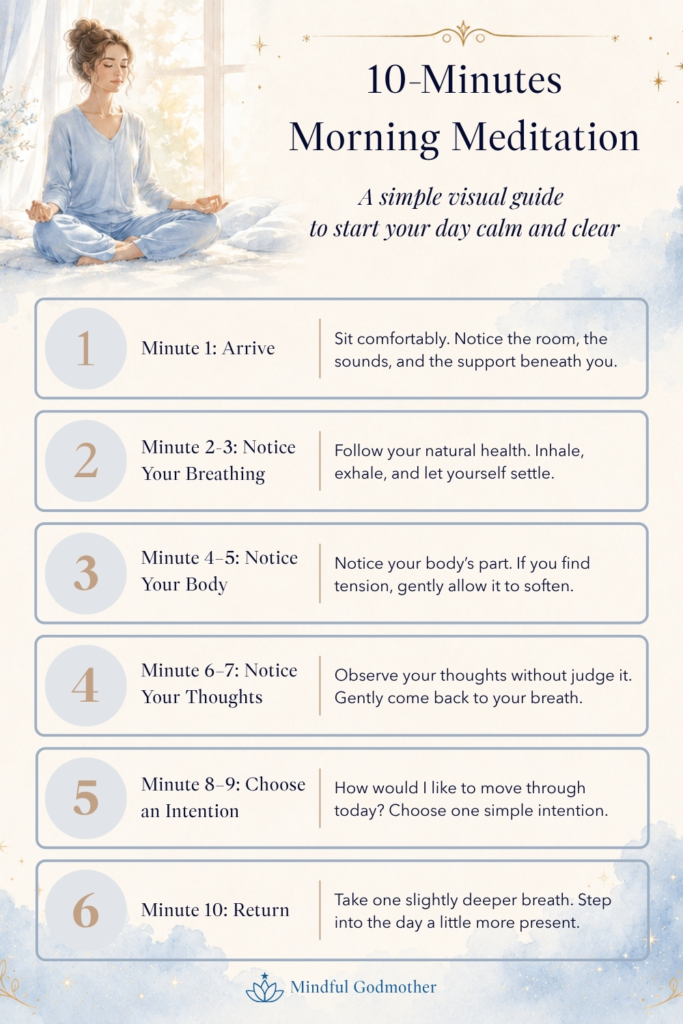
Minute 1: Arrive
Sit somewhere comfortable.
You can use a chair, sofa, cushion, or the edge of your bed.
Let your hands rest naturally.
Close your eyes if that feels comfortable, or soften your gaze.
- Notice the support beneath your body.
- Notice the sounds around you.
- Notice the temperature of the room.
Then quietly remind yourself:
I’m here.
For these few minutes, there is nowhere else you need to be.
Minutes 2–3: Notice Your Breathing
Bring your attention to your natural breathing.
You do not need to take unusually deep breaths.
Simply notice your breath as it is.
Perhaps you feel your chest rising and falling.
Maybe you notice your abdomen moving.
Or perhaps you feel the air passing through your nose.
Choose one place where the breath feels easiest to notice.
Breathing in.
Breathing out.
Nothing to achieve.
Minutes 4–5: Notice Your Body
Slowly bring awareness through your body.
Notice your forehead.
Jaw.
Shoulders.
Chest.
Stomach.
Hands.
Legs.
Feet.
If you find tension somewhere, you do not need to force it away.
Simply notice:
“There is tension here.”
If the area naturally softens, let it.
If it does not, that is okay too.
Minutes 6–7: Notice Your Thoughts
Now notice what your mind is doing.
Maybe you are planning your day.
Thinking about work.
Remembering yesterday.
Wondering whether you are meditating correctly.
All of that is normal.
You have not failed because you are thinking.
When you notice that your mind has wandered, gently return your attention to the breath.
You may need to do this many times.
That returning is part of meditation.
Minutes 8–9: Choose an Intention
Ask yourself:
How would I like to move through today?
Choose something simple.
Perhaps:
- I want to be patient.
- I want to slow down when I can.
- I want to speak kindly to myself.
- I want to listen carefully.
- I want to remember that I don’t need to solve everything at once.
Choose one intention that feels supportive rather than demanding.
Minute 10: Return
Take one slightly deeper breath.
Notice your body again.
Notice the room around you.
When you are ready, gently open your eyes or lift your gaze.
Before reaching for your phone or standing up, give yourself one final moment.
Then begin your day.
Not perfectly.
Just a little more consciously.
How to Make Morning Meditation a Habit
Instead of promising yourself:
“I will meditate for twenty minutes every morning forever,”
start smaller.
Try:
For the next seven mornings, I will meditate for three minutes.
You can also connect meditation to something you already do.
For example:
After I brush my teeth, I will meditate for five minutes.
Or:
After I make my coffee, I will sit quietly before checking my phone.
Attaching meditation to an existing habit can make it easier to remember.
You might also keep a tiny meditation journal.
After each practice, write one sentence:
Today I noticed ________.
Perhaps:
- Today I noticed I was rushing.
- Today I noticed my shoulders were tense.
- Today I noticed I felt peaceful.
- Today I noticed I did not want to meditate.
Even the last answer is useful.
Mindfulness is not about discovering only pleasant things.
It is about noticing what is actually there.
Common Morning Meditation Challenges
“I Can’t Stop Thinking.”
You do not need to.
Meditation is not about having an empty mind.
When you notice yourself thinking, simply return your attention to the breath.
The moment you realize your mind has wandered is actually a moment of awareness.
“I Keep Getting Distracted.”
Everyone does.
Sounds, thoughts, sensations, memories, and plans will appear.
Notice the distraction.
Then return.
You may repeat this process many times during one meditation session.
You are still meditating.
“I Don’t Feel Calm Afterwards.”
Meditation does not always create immediate calm.
Some sessions feel peaceful.
Others feel restless or uncomfortable.
Sometimes meditation simply helps you notice that you were already stressed.
The goal is not to manufacture a particular emotion.
The goal is awareness.
“I Missed Several Days.”
Begin again.
- No punishment.
- No catching up.
- No starting over from zero.
Meditation is not a streak that you can ruin.
Returning is part of the practice.
Morning Meditation FAQs
Is morning meditation good for beginners?
Yes. Morning meditation can be very simple. Beginners can start by sitting comfortably for one to five minutes and paying attention to their natural breathing.
Should I meditate before or after breakfast?
Either is fine. Some people prefer meditating before breakfast because the morning is quieter, while others feel more comfortable afterwards. Choose what works best for your routine.
Should I meditate before checking my phone?
If possible, meditating before checking notifications can give you a quieter beginning to your morning. It allows you to choose where your attention goes before messages, news, email, and social media compete for it.
Can I meditate while lying in bed?
Yes. However, you may fall back asleep. If you want to remain alert, sitting upright on your bed or in a chair may work better.