Meditation is often described as a way to “clear your mind.” But that description can make the practice sound much more mysterious—and much more difficult—than it really is.
At its simplest, meditation is a practice of intentionally paying attention. You might notice your breathing, sensations in your body, sounds around you, or the thoughts passing through your mind. When your attention wanders, as it naturally will, you gently bring it back.
And you do that again and again.
The benefits of meditation aren’t about becoming endlessly calm or eliminating difficult thoughts. Meditation can instead help you develop a different relationship with what is happening inside you: more awareness, a little more space before reacting, and sometimes a greater sense of steadiness.
Research suggests that meditation and mindfulness practices may support stress management, emotional well-being, sleep, and other aspects of mental and physical health. At the same time, meditation isn’t a cure-all, and the strength of the evidence varies depending on the benefit being studied.
Here are some of the most meaningful ways meditation may support your everyday life.
What Is Meditation?
Meditation is an umbrella term for many practices that bring intentional awareness to the mind and body.
Some types of meditation involve focusing on one thing, such as:
- your breath
- a word or mantra
- sounds
- physical sensations
- an image
- loving or compassionate thoughts
Mindfulness meditation, one of the most widely studied forms, involves bringing attention to the present moment without immediately judging what you notice.
You don’t need to stop thinking to meditate.
In fact, noticing that your mind has wandered and gently returning your attention is part of the practice itself.
Think of meditation less as controlling your mind and more as learning how to notice where your mind goes.
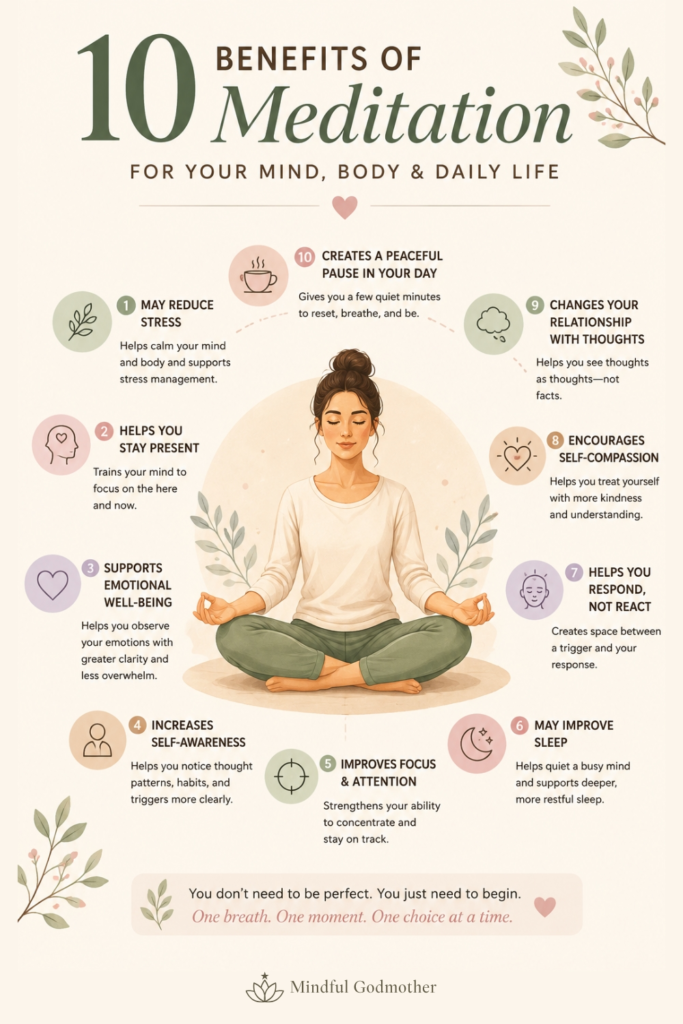
1. Meditation May Help Reduce Stress
Stress is one of the most common reasons people begin meditating.
When you’re stressed, your attention can become trapped in a cycle of worries:
What if this goes wrong?
How am I going to manage everything?
Why did I say that yesterday?
Meditation gives you an opportunity to notice those thoughts without automatically following every one of them.
Research on mindfulness-based approaches suggests they may help reduce perceived stress and symptoms associated with anxiety and depression.
That doesn’t mean meditation removes the circumstances causing your stress.
Your deadline still exists.
The difficult conversation may still need to happen.
The bills still need to be paid.
But meditation may help create a little more space between the stressful situation and your response to it.
Sometimes, that space is exactly what we need.
2. Meditation Can Help You Become More Present
How much of your day do you spend physically in one place while mentally somewhere else?
You might be eating breakfast while thinking about work, having a conversation while checking your phone, or lying in bed replaying something that happened hours earlier.
This is normal. Our minds wander.
Meditation trains the skill of noticing when your attention has drifted and returning to what is happening now.
You begin with something simple:
I’m breathing.
My feet are touching the floor.
I can hear birds outside.
Over time, that same awareness can begin appearing outside meditation.
You may notice the taste of your coffee instead of drinking it automatically. You might realize you’re becoming irritated before you snap at someone. Or you may catch yourself worrying about tomorrow and gently return to today.
Presence doesn’t mean ignoring the future.
It means not missing your current life because your mind is constantly somewhere else.
3. Meditation May Support Emotional Well-Being
One of the quieter benefits of meditation is learning that you can experience an emotion without immediately becoming consumed by it.
Suppose anxiety appears.
Instead of automatically thinking:
Something is wrong. I need to make this feeling disappear.
Meditation may help you recognize:
Anxiety is here right now.
That small change in perspective can matter.
You’re no longer pretending the emotion doesn’t exist. But you’re also not necessarily treating it as a command.
Mindfulness-based approaches have shown benefits for some people experiencing anxiety and depressive symptoms, although results vary and meditation should not be viewed as a replacement for appropriate professional treatment.
Meditation may gradually teach you to meet emotions with curiosity rather than immediate resistance.
And sometimes an emotion becomes easier to carry once you stop fighting the fact that it’s there.
4. Meditation Can Increase Self-Awareness
It’s difficult to change a pattern you haven’t noticed.
Perhaps you automatically say yes when you really want to say no.
Maybe criticism immediately triggers defensiveness.
Perhaps stress sends you toward scrolling, snacking, overworking, withdrawing, or repeatedly checking your phone.
Meditation gives you an opportunity to observe these internal patterns.
Not to judge them.
Just to notice them.
You may begin recognizing:
This is what happens in my body when I feel overwhelmed.
Or:
I tend to assume the worst when I don’t know what someone is thinking.
Awareness doesn’t instantly change a habit.
But it gives you something incredibly useful: a moment in which another choice becomes possible.
5. Meditation May Improve Focus and Attention
Meditation can be thought of as a gentle form of attention training.
Imagine you’re focusing on your breath.
After several seconds, you’re thinking about lunch.
You notice.
You return to your breath.
Thirty seconds later, you’re remembering an awkward conversation from three years ago.
You notice.
You return again.
That returning is not evidence that you’re bad at meditation.
That returning is the practice.
Meditation trains you to recognize distraction and redirect attention. Research also suggests meditation may influence processes related to attention, emotion regulation, and self-awareness.
That can be particularly useful in a world filled with notifications, open tabs, endless feeds, and constant demands for your attention.
6. Meditation May Help You Sleep Better
Trying hard to sleep often has the frustrating effect of keeping us awake.
Your body is in bed, but your mind has opened a late-night meeting:
Did I finish everything today?
What needs to happen tomorrow?
Why hasn’t that person replied?
What was that strange noise downstairs?
Mindfulness meditation may help some people experiencing sleep difficulties. Research reviewed by the National Center for Complementary and Integrative Health suggests mindfulness meditation can improve sleep quality, although it is not necessarily more effective than established approaches such as cognitive behavioral therapy or exercise.
A gentle bedtime meditation can help shift your attention away from solving problems and toward noticing your breathing and body.
The goal isn’t to force yourself to sleep.
It’s simply to stop asking your mind to solve your entire life at midnight.
7. Meditation May Help You Respond Rather Than React
Imagine someone makes a comment that irritates you.
The automatic sequence might look like this:
Comment → anger → reaction.
Meditation can help you become more aware of what happens in the middle:
Comment → tension in chest → angry thought → urge to respond → choice.
You may still decide to speak up.
Meditation doesn’t mean becoming passive, endlessly agreeable, or unaffected by other people’s behavior.
Instead, greater awareness can help you decide how you want to respond.
- Sometimes you speak.
- Sometimes you wait.
- Sometimes you set a boundary.
- Sometimes you realize the situation isn’t worth your energy.
- The difference is that your response becomes more intentional.
8. Meditation Can Encourage Self-Compassion
Pay attention to how you talk to yourself when meditation doesn’t go perfectly.
You may notice thoughts like:
I can’t do this.
I’m terrible at meditating.
Why can’t I concentrate?
And there is your practice.
Instead of criticizing yourself, meditation gives you another opportunity to respond gently:
My mind wandered. That’s okay. I’ll come back.
Again.
And again.
This attitude can gradually extend beyond meditation.
You made a mistake.
Come back.
You had a difficult day.
Come back.
You lost your patience.
Notice it, repair what needs repairing, and come back.
Meditation doesn’t require perfection.
It gives you repeated practice at beginning again.
9. Meditation May Change Your Relationship With Difficult Thoughts
Thoughts can feel surprisingly convincing.
I’m going to fail.
They don’t like me.
Nothing is going to change.
When a thought appears repeatedly, we may begin treating it as a fact.
Meditation can help you notice something important:
A thought is something your mind produces. It isn’t automatically reality.
You don’t have to argue with every negative thought.
Sometimes simply recognizing,
I’m having the thought that I’m going to fail,
creates enough distance to see the situation differently.
This doesn’t mean ignoring real problems or replacing uncomfortable thoughts with forced positivity.
It means learning that you can observe a thought before deciding whether it deserves your attention.
10. Meditation Can Create a Small Pause in a Busy Day
Not every benefit of meditation needs to be dramatic.
Sometimes meditation simply gives you five quiet minutes.
Five minutes without answering messages.
- Without producing something.
- Without checking whether someone needs you.
- Without consuming another piece of information.
Just breathing.
For someone whose day feels constantly full, that pause can be meaningful.
Meditation doesn’t always need to be another form of self-improvement.
Sometimes you are allowed to sit quietly because being a person is already enough work for one day.
Make Meditation Part of Your Morning
If you’d like to turn meditation into a regular habit, the morning can be a gentle place to begin. Practicing before the day becomes busy may give you a quiet moment to check in with yourself, settle your attention, and start the day with a little more intention.
You don’t need a long or complicated routine, either. Even a few mindful minutes can be meaningful. If you’d like some guidance, try our 10-minute morning meditation for a simple, beginner-friendly practice you can return to whenever you want a calmer and clearer start to your day.
Frequently Asked Questions About the Benefits of Meditation
Is 10 minutes of meditation a day enough?
Ten minutes can be a very reasonable meditation practice, especially for beginners. You don’t need long sessions to begin developing greater awareness of your breathing, thoughts, emotions, and attention patterns.
The most useful meditation practice is usually one you can maintain consistently.
What happens if you meditate every day?
With regular practice, you may become quicker at noticing distraction, emotional reactions, physical tension, and repetitive thought patterns.
You may also find it easier to intentionally return your attention to what is happening in the present moment.
But meditation affects people differently, and you shouldn’t expect every session—or every person—to experience the same results.
How quickly do you notice the benefits of meditation?
Some people feel calmer after a single meditation session.
Other benefits may become noticeable only after practicing regularly for several weeks or longer.
Instead of continually asking, Is meditation working yet?, notice small changes in everyday life.
Are you recognizing stress earlier?
Are you slightly less reactive?
Do you catch yourself when your thoughts begin spiraling?
Those small moments may be more meaningful than experiencing perfect calm during meditation.
Do I have to stop thinking while meditating?
No.
Your brain produces thoughts. Meditation isn’t about turning that process off.
When a thought appears, notice it.
When you realize you’ve become absorbed in it, gently bring your attention back.
You may repeat this dozens of times in one session.
That’s completely normal.
Is meditation the same as mindfulness?
They’re closely related but not identical.
Meditation usually refers to a deliberate practice in which you set aside time to focus your attention or awareness.
Mindfulness refers more broadly to paying attention to your present experience with openness and less judgment.
You can practice mindfulness while meditating, but you can also practice it while walking, eating, listening to someone, washing dishes, or drinking your morning coffee.