You do not need 30 quiet minutes, a perfectly peaceful room, or years of experience to meditate.
Sometimes, five minutes is enough to pause, notice how you are feeling, and come back to the present moment.
A 5 minute meditation is especially helpful when meditation sounds appealing but finding time for it feels difficult. You can practice shortly after waking up, between tasks, during a lunch break, after a stressful moment, or before going to bed.
And you do not have to make your mind completely quiet.
You simply need a few minutes to stop doing, start noticing, and gently return your attention to what is happening right now.
Below is a simple 5 minute meditation for beginners that you can return to whenever you need a small pocket of calm in your day.
What Is a 5 Minute Meditation?
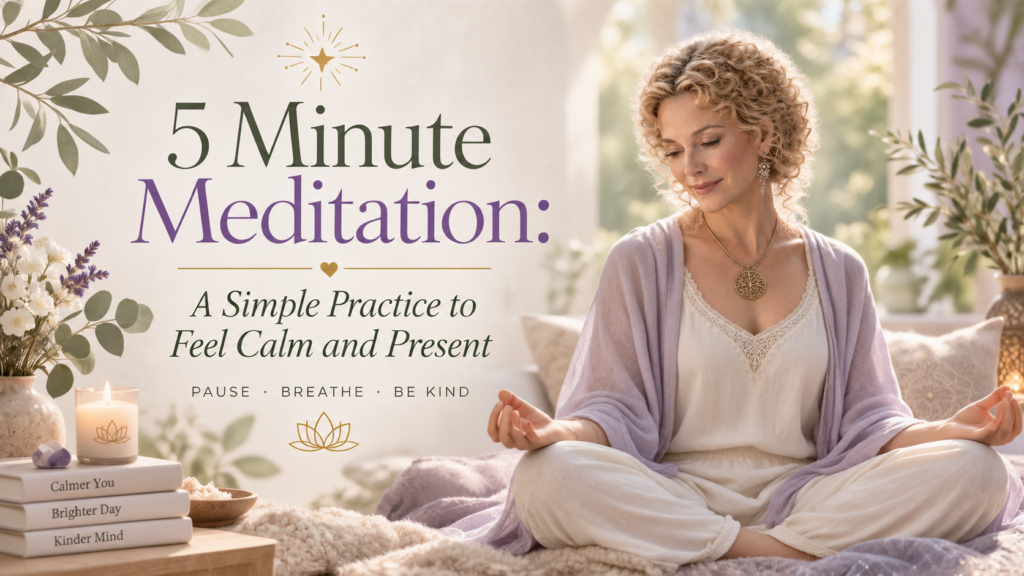
A 5 minute meditation is exactly what it sounds like: a short meditation practice lasting about five minutes.
You might focus on:
- your breathing
- sensations in your body
- sounds around you
- a calming word or phrase
- your thoughts and emotions without trying to change them
Mindfulness meditation generally involves bringing awareness to the present moment and noticing your experience without immediately judging it.
Five minutes may sound almost too short to matter, but meditation does not have to be long to be worthwhile as a practice.
The purpose of these five minutes is not to transform your entire day or make every stressful feeling disappear.
It is simply to give yourself a moment to notice, breathe, and reconnect with yourself before moving forward.
That alone can be meaningful.
Is 5 Minutes of Meditation Enough?
Yes—five minutes is enough to practice meditation.
It may not produce the same experience as a longer meditation session, and there is no reason to expect five minutes to solve anxiety, stress, insomnia, or another health concern on its own.
But a short practice can still help you learn one of meditation’s most useful skills:
noticing where your attention has gone and gently bringing it back.
Research on mindfulness and meditation suggests these practices may be helpful for areas such as stress, anxiety, depression, and sleep, although results vary and some research remains preliminary or mixed.
So rather than asking:
“Is five minutes enough to get all the benefits of meditation?”
A gentler question may be:
“Can I give myself five mindful minutes today?”
If five minutes is realistic enough that you actually practice, it can be a very good place to begin.
A Simple 5 Minute Meditation for Beginners
Find somewhere you can be reasonably comfortable for the next five minutes.
You can sit on a chair, meditation cushion, sofa, or the edge of your bed. You can even practice standing if that feels better.
There is no need to create a perfect meditation environment.
Set a gentle five-minute timer if you would rather not watch the clock.
Then begin.
Minute 1: Arrive
Allow your body to settle into whatever position you have chosen.
You do not need to sit perfectly straight. Simply find a posture that feels both comfortable and reasonably alert.
Let your hands rest naturally.
If it feels comfortable, close your eyes. Otherwise, soften your gaze toward the floor or an object in front of you.
Notice that you have stopped for a moment.
Feel the surface beneath you.
Notice the weight of your body.
You do not have to feel calm yet.
Just arrive.
Take one slow breath in.
And let it go.
Minute 2: Notice Your Breathing
Bring your attention toward your breath.
There is no need to force yourself to breathe deeply.
Simply notice your natural breathing.
You might feel:
- air moving through your nose
- your chest gently rising and falling
- your belly expanding and softening
- subtle movement somewhere else in your body
Choose whichever sensation is easiest to notice.
Stay with one breath.
Then the next.
And the next.
When your mind wanders—which is completely normal—notice where it went and gently return to your breathing.
You are not failing when your mind wanders.
Returning is part of the meditation.
Minute 3: Check In With Your Body
Now allow your attention to widen.
Notice how your body feels.
Perhaps your shoulders are tight.
Your jaw may be clenched.
Your hands may be warm.
Your stomach may feel unsettled.
Or perhaps you simply feel tired.
There is no need to analyze these sensations.
For a few moments, practice noticing without immediately trying to fix anything.
If you discover tension somewhere, see whether that area can soften slightly.
Let your shoulders drop.
Relax your hands.
Unclench your jaw if you can.
Then return to the gentle rhythm of your breath.
Minute 4: Notice Your Thoughts
For the next minute, notice what your mind is doing.
Perhaps you are planning dinner.
Replaying a conversation.
Thinking about work.
Remembering something embarrassing.
Wondering whether you are meditating correctly.
You do not need to follow every thought.
Imagine each thought as something passing through your awareness rather than something you must solve immediately.
You can quietly acknowledge:
“Thinking.”
Then come back to your breath.
Another thought appears?
Notice it.
And return again.
You may do this twenty times.
That is okay.
Minute 5: Come Back to Your Day
For the final minute, let go of trying to focus so closely.
Notice your whole body again.
Notice your breathing.
Notice the sounds around you.
Notice the room you are in.
Before finishing, ask yourself one simple question:
How do I feel right now?
Do not search for the “right” answer.
Maybe you feel calmer.
Maybe nothing has changed.
Maybe you have simply noticed how tired or tense you were.
All of those experiences are valid.
Take one final slow breath.
Then gently open your eyes or lift your gaze.
Your five minutes are complete.
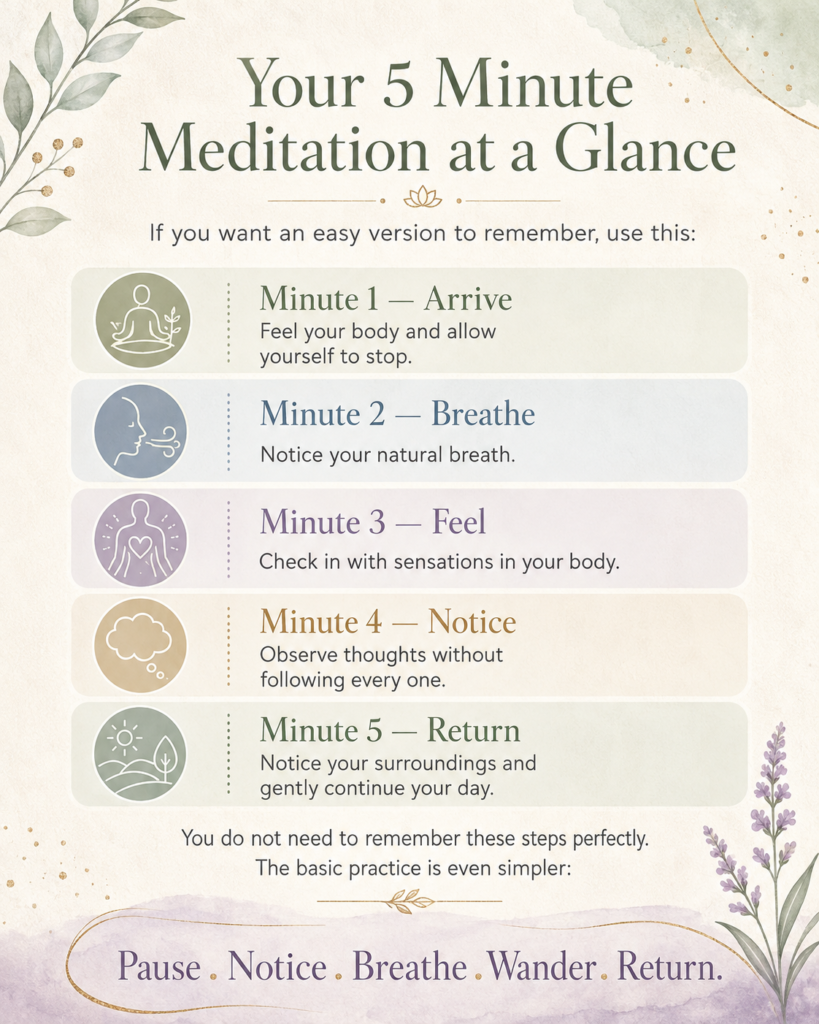
Your 5 Minute Meditation at a Glance
If you want an easy version to remember, use this:
Minute 1 — Arrive
Feel your body and allow yourself to stop.
Minute 2 — Breathe
Notice your natural breath.
Minute 3 — Feel
Check in with sensations in your body.
Minute 4 — Notice
Observe thoughts without following every one.
Minute 5 — Return
Notice your surroundings and gently continue your day.
You do not need to remember these steps perfectly.
The basic practice is even simpler:
Pause. Notice. Breathe. Wander. Return.
What If I Can’t Stop Thinking?
One of the most common beginner worries is:
“I tried meditation, but I couldn’t stop thinking.”
Fortunately, stopping every thought is not the goal.
The mind thinks.
That is what minds do.
During five minutes of meditation, you may think about your grocery list, a meeting tomorrow, a text you forgot to answer, or what you are going to eat later.
You might even spend half the meditation wondering how many minutes are left.
When you realize your attention has wandered, simply notice it.
Then return to your breath.
No frustration required.
You can think of every return as a tiny repetition of the practice:
Notice → return.
Notice → return.
Notice → return.
Meditation is not about maintaining perfect concentration.
It is about learning to recognize when you have drifted away and practicing coming back.
When Is the Best Time for a 5 Minute Meditation?
There is no single best time.
The most useful time is often the one that fits naturally into your life.
In the morning
A short meditation can create a gentle transition between waking up and immediately entering emails, news, responsibilities, and to-do lists.
If you enjoy beginning your day slowly, you may also like our Morning Meditation practice.
During a work break
Instead of filling every break by scrolling on your phone, try sitting quietly for five minutes.
You do not have to make the break productive.
Simply allow yourself to stop receiving information for a moment.
Before a difficult conversation
Five quiet minutes can give you space to notice what you are feeling before you speak.
You might ask:
- What am I feeling?
- What am I afraid of?
- What matters most in this conversation?
- How do I want to show up?
The goal is not to eliminate your emotions, but to become a little more aware of them.
After a stressful moment
When something upsetting happens, you may not be ready for a long meditation.
Five minutes can feel more approachable.
Sit somewhere safe, notice your breathing, feel your feet or body supported beneath you, and allow yourself to reconnect with the present.
Before bed
A brief meditation can also become part of a quieter nighttime routine.
If concentrating on the breath feels uncomfortable, try listening to sounds around you or slowly noticing sensations from your feet upward.
How to Make 5 Minute Meditation a Daily Habit
You do not have to begin with a goal of meditating every single day forever.
Try making the practice small enough that it fits your actual life.
Attach meditation to something you already do
For example:
After I make my morning coffee, I will meditate for five minutes.
Or:
After I close my laptop for work, I will sit quietly for five minutes.
An existing routine can become a reminder.
Keep your meditation space simple
You do not need a dedicated meditation room.
A chair beside your bed may be enough.
A cushion in the corner may be enough.
A quiet parked car may be enough.
Comfort matters more than creating an Instagram-perfect meditation space.
Use the same simple practice
Beginners sometimes spend more time searching for the perfect technique than actually meditating.
You can repeat the five-minute practice above for days or weeks.
Familiarity can make it easier to begin.
Let five minutes remain five minutes
You do not have to keep increasing the length.
If you eventually want to meditate for 10, 15, or 20 minutes, wonderful.
But a five-minute practice does not need to become something bigger to be worthwhile.
Sometimes a small practice is exactly what makes consistency possible.
5 Minute Meditation for Anxiety or Overwhelm
If you are feeling anxious or overwhelmed, meditation does not need to become another task you have to perform correctly.
Try making the practice more grounding.
Instead of focusing only on your breath, notice physical sensations around you:
Feel your feet against the floor.
Notice your back against the chair.
Listen for three sounds.
Notice the temperature of the air.
Feel your hands resting in your lap.
Then gently return to your breathing if that feels comfortable.
Meditation and mindfulness may help some people with stress or anxiety symptoms, but they are not substitutes for professional medical or mental health care when you need it.
And meditation does not feel calming for everyone. If closing your eyes, focusing inward, or sitting still makes you feel significantly worse, you can stop. You might instead try walking slowly, keeping your eyes open, listening to gentle music, or speaking with an appropriate health professional.
Mindfulness should be something that supports you—not something you force yourself through.
You Don’t Have to Be Good at Meditation
There may be days when five minutes feels peaceful.
There may be days when your mind races the entire time.
You may feel relaxed afterward.
Or restless.
Or sleepy.
Or exactly the same.
None of these experiences automatically means you did meditation correctly or incorrectly.
Instead of measuring your practice by how calm you became, consider asking:
Did I show up for these five minutes?
If the answer is yes, the practice happened.
That is enough.
Frequently Asked Questions About 5 Minute Meditation
Is a 5 minute meditation good for beginners?
Yes. Five minutes can be an approachable starting point because it gives you enough time to practice focusing and returning your attention without requiring a large commitment.
You can always stay with five minutes or gradually experiment with longer sessions later.
How often should I do a 5 minute meditation?
You can meditate as often as feels useful and sustainable for you.
Some people prefer a short daily practice. Others meditate several times a week or simply use five-minute meditations during particularly busy or stressful days.
Consistency can be helpful, but meditation does not need to become another source of guilt.
Can I meditate lying down?
Yes.
You can meditate sitting, standing, walking, or lying down.
If you tend to fall asleep when lying down and want to remain alert, sitting may work better. But if lying down is the most comfortable or accessible position for your body, it is perfectly reasonable to practice that way.
Should I breathe deeply during meditation?
Not necessarily.
For a simple mindfulness meditation, you can simply notice your natural breathing.
You may begin with one or two slower breaths if that feels comfortable, then allow your breath to return to its usual rhythm.
What should I think about while meditating?
You do not need to deliberately think about anything.
Choose something simple to rest your attention on—often the breath.
Thoughts will naturally appear. When you notice them, gently return to the breath or another point of focus.
Is morning or evening better for meditation?
Neither is universally better.
Morning meditation may help you begin the day more intentionally, while evening meditation can create a quieter transition toward rest.
Try both and notice which one fits your life more naturally.
A Gentle Five-Minute Pause Can Be Enough
Meditation can easily become another thing we think we need to do perfectly.
The right cushion.
The right music.
The right posture.
The right amount of time.
But mindfulness can begin much more simply.
Sit down.
Notice where you are.
Feel one breath.
Notice when your mind wanders.
Come back.
And continue for five minutes.
You do not have to leave the meditation feeling like a different person.
Sometimes the most meaningful thing about a 5 minute meditation is simply that, for five minutes, you gave yourself permission to stop rushing and pay attention to your own experience.
And tomorrow, if you want to, you can come back and do it again.
Gentle health note: Meditation and mindfulness are generally considered low-risk for many people, but negative experiences can occur, and meditation should not be used to replace appropriate medical or mental health care.