Sometimes meditation becomes easier when you have something simple and real to focus on.
A leaf.
The texture of a stem.
The way sunlight falls across a plant.
The slow appearance of a new shoot.
That is the idea behind plants meditation: using a plant as a gentle anchor for your attention.
You do not need a garden, a collection of rare houseplants, or a perfectly peaceful home. One small plant on a windowsill is enough.
Instead of trying to empty your mind, you simply spend a few quiet minutes noticing what is already in front of you.
For beginners especially, meditating with plants can feel more approachable than sitting with closed eyes and trying to concentrate only on the breath.
It gives your attention somewhere soft to land.
What Is Plants Meditation?
Plants meditation is a simple mindfulness practice in which you use a plant, flower, tree, or other piece of living nature as the focus of your attention.
You might notice:
- the shape of the leaves
- variations in color
- the texture of the soil
- the direction the plant is growing
- tiny imperfections
- new growth
- the movement of leaves in the air
- the way light and shadow change its appearance
There is nothing you need to achieve.
You are simply practicing being present with what you can see, feel, and notice.
In this way, a plant becomes a meditation anchor—similar to the breath, a sound, a candle flame, or sensations in the body.
The plant is not doing the meditation for you.
It is simply helping you return your attention to the present moment.
Why Meditate With Plants?
There is something naturally unhurried about plants.
- They do not rush.
- They do not demand that you respond immediately.
- They grow according to their own rhythm.
When much of daily life involves notifications, deadlines, conversations, screens, and constant mental activity, quietly observing a plant offers a very different experience.
A plant meditation can give you a moment to slow your pace and notice details you would usually overlook.
That does not mean plants magically remove stress or that five minutes beside a houseplant will solve an emotional problem.
The value of the practice is simpler.
It creates a small opportunity to stop doing and start noticing.
And that is at the heart of mindfulness.
Plants Meditation for Beginners
If traditional meditation feels difficult, meditating with a plant can be a gentle place to start.
Many beginners assume meditation requires complete mental silence.
It does not.
Your mind will probably wander.
You may start thinking about dinner, work, tomorrow’s plans, or something someone said earlier.
That is normal.
The practice is not to prevent thoughts.
The practice is to notice when your attention has drifted and gently return it to your plant.
You might think:
“There is a thought.”
Then look again at the leaf.
- Notice its color.
- Notice its edges.
- Notice your breathing.
And begin again.
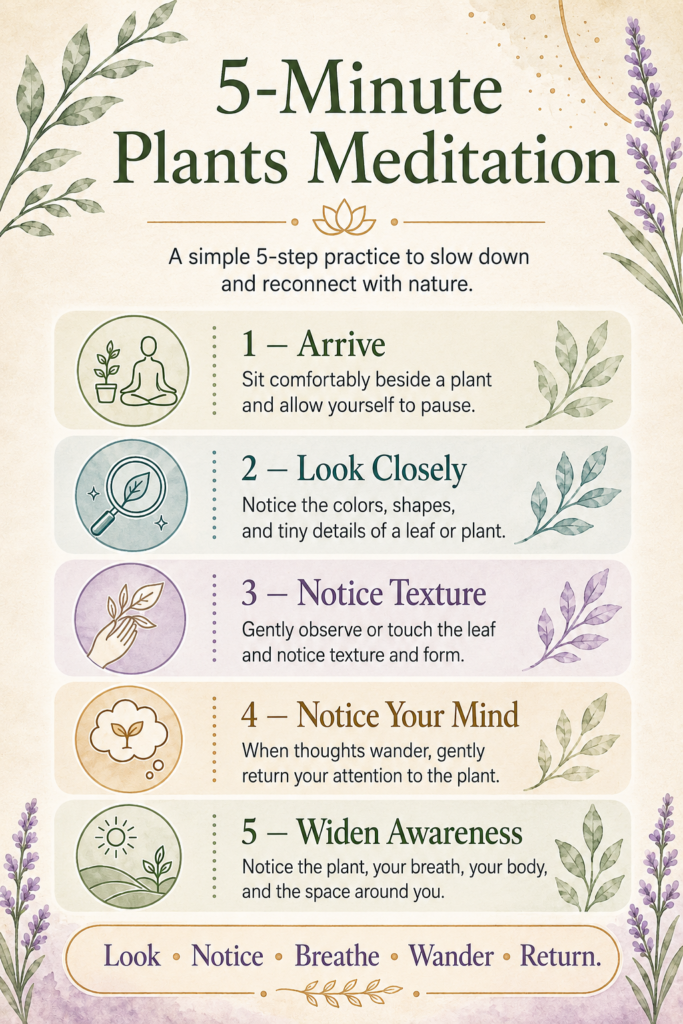
A Simple 5-Minute Plants Meditation
Choose one plant that you can comfortably sit near.
It can be a houseplant, herb, flower, tree, or even a small succulent.
Set a gentle five-minute timer if that helps you relax without checking the clock.
Then begin.
Minute 1: Arrive
Sit or stand somewhere comfortable near your plant.
Allow your hands to rest naturally.
Take one easy breath.
There is no need to breathe in a particular way.
Notice your body where it is.
Feel your feet on the floor.
Notice the chair beneath you if you are sitting.
Then allow your gaze to settle on the plant.
For this minute, simply arrive.
You do not need to feel peaceful.
You only need to be here.
Minute 2: Look Closely
Begin noticing the plant as though you were seeing it for the first time.
What colors do you see?
Perhaps what you normally call “green” is actually many shades of green.
Look at the shape of one leaf.
Notice its edges.
Look for lines or veins.
Observe where light touches the plant and where shadows appear.
Do not worry about identifying the plant or analyzing its condition.
For now, simply see it.
Minute 3: Notice Texture and Form
If the plant is safe to touch, you may gently feel one leaf between your fingers.
Notice whether it feels:
- smooth
- waxy
- soft
- thick
- delicate
- rough
- cool
- warm
If you prefer not to touch it, continue observing visually.
Notice how the stems connect.
Notice which leaves point upward and which lean outward.
Perhaps there is a small imperfection—a brown edge, a tiny tear, or an uneven shape.
Allow the plant to be exactly as it is.
Minute 4: Notice Your Mind
Now become aware of your own thoughts.
Has your mind wandered?
Maybe you are wondering whether the plant needs watering.
Perhaps you remembered something you need to do later.
Notice the thought without criticizing yourself.
Then gently return to the plant.
Look at one leaf.
Take one natural breath.
Notice another detail.
Whenever your mind wanders, come back.
Minute 5: Widen Your Awareness
For the final minute, allow your awareness to become wider.
- Notice the plant.
- Notice your breathing.
- Notice your body.
- Notice the room around you.
Listen for sounds nearby.
You might quietly ask yourself:
How do I feel right now?
There is no correct response.
- Perhaps you feel calmer.
- Perhaps you simply feel more aware.
- Perhaps nothing noticeable has changed.
All of those experiences are okay.
Take one final breath and continue with your day.
A Simple Phrase to Remember
You do not have to memorize every step.
Remember:
Look. Notice. Breathe. Wander. Return.
That is enough for a simple plants meditation practice.
Try a Leaf Meditation
If you want an even simpler version, choose one leaf.
Spend two to five minutes observing only that leaf.
Look closely at:
- its outline
- its center
- its veins
- the transition between colors
- small spots or markings
- how the light touches it
Your mind will probably start creating labels:
“Dark green.”
“Small leaf.”
“This one needs water.”
See whether you can move beyond the labels and simply look.
This practice can remind you how much detail exists in ordinary things when you stop long enough to notice.
Plants Meditation Through Touch
Mindfulness does not have to be purely visual.
Touch can become part of the meditation too.
Choose a plant that is safe and comfortable to handle.
Gently touch a leaf or stem.
Pay attention to the sensation.
Instead of immediately deciding whether it feels good or bad, simply notice.
You may feel differences between the upper and lower surface of a leaf.
You may notice that younger leaves feel different from older ones.
This sensory attention can help bring your awareness away from repetitive thoughts and toward what is happening right now.
Avoid touching plants that may irritate the skin, have sharp thorns, or may be toxic.
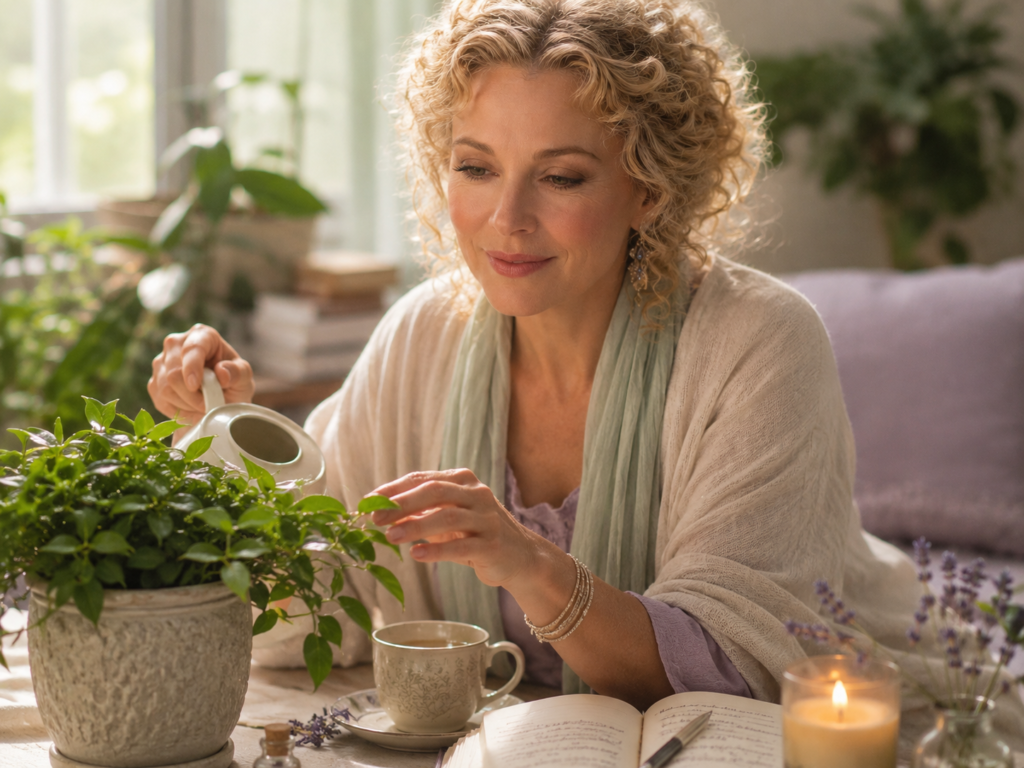
Mindful Plant Watering
Plant care itself can become a mindfulness practice.
Most of the time, watering plants is simply another household task.
But you can turn it into a small ritual of attention.
Before watering, pause.
Look at the soil.
Notice whether it appears dry or moist.
Feel the weight of the pot if appropriate.
Observe the plant.
Then slowly pour the water.
Listen to the sound.
Watch the soil change.
Notice whether water begins to drain from the pot.
Try to stay with the experience instead of simultaneously checking your phone or thinking through your to-do list.
You are still completing an ordinary task.
You are simply doing it with more attention.
Mindful Plant Care
The same idea works with other plant-care activities.
You might practice mindfulness while:
- wiping dust from leaves
- pruning dead growth
- repotting a plant
- turning pots toward the light
- checking new growth
- arranging cut flowers
- planting herbs
- tending a balcony garden
Choose one activity and do only that activity for a few minutes.
- Notice your hands.
- Notice the textures.
- Notice the smell of soil.
- Notice what you see.
When thoughts pull you somewhere else, gently come back to what your hands are doing.
Plants Meditation Without Houseplants
You do not need to own plants to practice.
Nature is already full of meditation anchors.
You might sit beside:
- a tree in a park
- grass
- wildflowers
- garden plants
- fallen leaves
- herbs growing outside
- a flowering bush
You can even practice while walking.
Choose a tree or plant along your route.
Stop for a minute.
Notice it.
Then continue walking.
A small moment of attention can become a form of everyday mindfulness.
Tree Meditation
Trees work especially well for people who enjoy meditating outdoors.
Stand or sit near a tree.
Notice the trunk first.
Look at the texture of the bark.
Follow the trunk upward with your eyes.
Notice how it divides into branches.
Then look at the leaves.
Notice their movement.
Listen.
You may hear leaves rustling, birds, traffic, people talking, or wind.
You do not need the environment to become silent.
Allow the sounds to be part of the moment.
Bring your attention back to the tree whenever your mind wanders.
Plants Meditation and Breathing
You can also combine plant observation with a traditional breathing meditation.
Choose a plant in front of you.
Breathe naturally.
On each inhale, notice one detail about the plant.
On each exhale, allow your body to soften slightly.
You might quietly think:
Inhale — notice.
Exhale — soften.
There is no need to make the breath unusually deep.
Comfortable, natural breathing is enough.
Continue for several minutes.
Morning Plants Meditation
Plants meditation can be especially pleasant in the morning.
Natural morning light can make small details easier to notice, and the practice provides an alternative to immediately reaching for your phone.
Try placing a plant near somewhere you already spend time in the morning.
It might be beside:
- your favorite chair
- the kitchen table
- a window
- your coffee or tea area
- your meditation space
Sit with the plant for three to five minutes before starting your usual routine.
If you enjoy beginning your day this way, you may also like a longer morning meditation practice.
Plants Meditation at Your Desk
You can use the same idea during work.
A small desk plant gives you a visual point of focus when you need a brief mindful break.
Instead of immediately switching from work to social media, try this:
Look away from your screen.
Look at your plant.
Take one natural breath.
Notice three details.
Feel your feet on the floor.
Relax your shoulders if they are tense.
Then return to your work.
This does not need to become a formal meditation session.
Even one mindful minute can interrupt the feeling that every moment of the day needs to be filled with information.
Plants Meditation Before Bed
You can also practice in the evening.
Choose a plant somewhere away from bright screens.
Sit quietly beside it.
Keep the lighting soft.
Rather than examining every detail intensely, allow your gaze to rest gently.
- Notice the plant.
- Notice your breathing.
- Notice your body.
Allow the practice to be slow.
If your mind starts planning tomorrow, acknowledge the thought and return to what you can see.
What If I Can’t Concentrate?
You do not need perfect concentration.
Some days you may spend five minutes deeply absorbed in the plant.
Other days your mind may wander every few seconds.
Both can still be meditation.
Try not to evaluate the session based on how peaceful you felt.
Instead ask:
Did I notice when my attention wandered?
Did I practice returning?
If you did, you practiced mindfulness.
What If Looking at a Plant Feels Boring?
That can actually become part of the practice.
We are accustomed to constant stimulation.
Videos change every few seconds.
Notifications appear.
Music plays.
Messages arrive.
A plant does very little on demand.
If boredom appears, notice the sensation.
What does boredom feel like?
Do you immediately want to reach for your phone?
Does your mind begin searching for something more exciting?
You do not need to fight that impulse.
Simply notice it.
Then see if you can stay with the plant for another breath.
This can teach you something interesting about attention itself.
Create a Small Plant Meditation Corner
A dedicated meditation space is optional, but creating a simple corner can make the habit easier to remember.
You might include:
- one or two plants
- a comfortable cushion or chair
- soft natural light
- a candle
- a journal
- calming meditation music
Keep the space simple.
The goal is not to create a perfect aesthetic.
The goal is to make it easy to sit down.
If you already use meditation music, you could play a gentle instrumental track quietly in the background while keeping the plant as your main visual anchor.
Which Plants Are Best for Meditation?
There is no specific plant you need.
Choose something you enjoy looking at.
Some people may prefer leafy plants because they offer many shapes and textures to observe.
Others may like the simplicity of a succulent.
Flowers can offer color and detail.
Herbs can introduce scent.
A few possibilities include:
Pothos — flowing vines and varied leaves.
Peace lily — broad leaves and simple forms.
Snake plant — strong upright patterns.
Monstera — distinctive leaf shapes.
Succulents — small and detailed.
Herbs — sensory interest through shape and scent.
Orchids — delicate flowers that invite close observation.
But the “best” meditation plant is simply one you already have and enjoy.
You do not need to buy anything to begin.
Plants Meditation and Journaling
After your meditation, you may want to write for a few minutes.
Try one of these prompts:
What did I notice that I normally overlook?
What did my mind keep returning to?
How did my body feel before and after the practice?
What happens inside me when I slow down?
What might I learn from allowing things to grow at their own pace?
The journal does not need to become an analysis of the meditation.
A few sentences are enough.
A Meditation on Growth
Plants can also provide a gentle reflection point.
Growth is rarely visible from moment to moment.
You may look at the same plant every day and feel that nothing is changing.
Then one morning you notice a new leaf.
Human growth can sometimes feel similar.
Not every change is dramatic.
Not every meaningful step is immediately visible.
You can use your plants meditation as a moment to reflect:
What am I quietly growing toward?
Then let the question rest.
You do not have to find an answer immediately.
Frequently Asked Questions About Plants Meditation
What does plants meditation mean?
Plants meditation is a mindfulness practice that uses a plant, flower, tree, or other natural object as the focus of attention.
You observe details such as shape, color, texture, movement, and light while gently returning your attention whenever your mind wanders.
Can plants help with meditation?
Plants can provide a simple visual and sensory anchor for meditation.
Some people find focusing on an external object easier than closing their eyes and focusing only on the breath.
The plant itself is not responsible for creating a meditative state. It simply gives you something present and tangible to notice.
How long should a plant meditation last?
There is no required length.
Try:
- 1 minute for a work break
- 5 minutes for a simple daily practice
- 10 minutes for slower observation
- 15 minutes or longer if you enjoy it
Starting small is perfectly fine.
Can I meditate while gardening?
Yes.
Gardening activities can become mindful practices when you deliberately bring your attention to what you are doing.
Notice the soil, plants, movement of your hands, sounds around you, and sensations in your body.
When your thoughts wander, return to the activity.
Do I need a special meditation plant?
No.
Any safe plant that you enjoy observing can work.
A plant you already own is enough.
Can beginners practice plants meditation?
Yes.
It can be especially accessible for beginners because the plant gives you something concrete to focus on.
Instead of wondering what you are supposed to think about during meditation, you can simply return to what you see.
Come Back to What Is Growing
Mindfulness does not always require closing your eyes.
Sometimes it can begin by looking more closely at something that has been beside you all along.
A leaf.
A flower.
A small herb growing toward the window.
A tree moving quietly in the wind.
With plants meditation, the practice is simple:
Look.
Notice.
Breathe.
Let your attention wander.
And gently come back.
- You do not need to become completely calm.
- You do not need to stop thinking.
- You do not even need more than a few minutes.
- You are simply practicing the ability to be here—with yourself and with something living in front of you.
And sometimes, that small moment of attention is enough to make an ordinary part of your day feel a little more spacious.