Meditation is often pictured as someone sitting perfectly still on the floor, legs crossed, back straight, and looking completely comfortable.
Real life can look a little different.
Your lower back starts aching. One foot falls asleep. Your hips feel tight. Your knees don’t particularly enjoy sitting cross-legged, and instead of noticing your breath, you spend most of your meditation wondering when you can move again.
If sitting comfortably is one of the things making meditation difficult for you, a meditation chair may help.
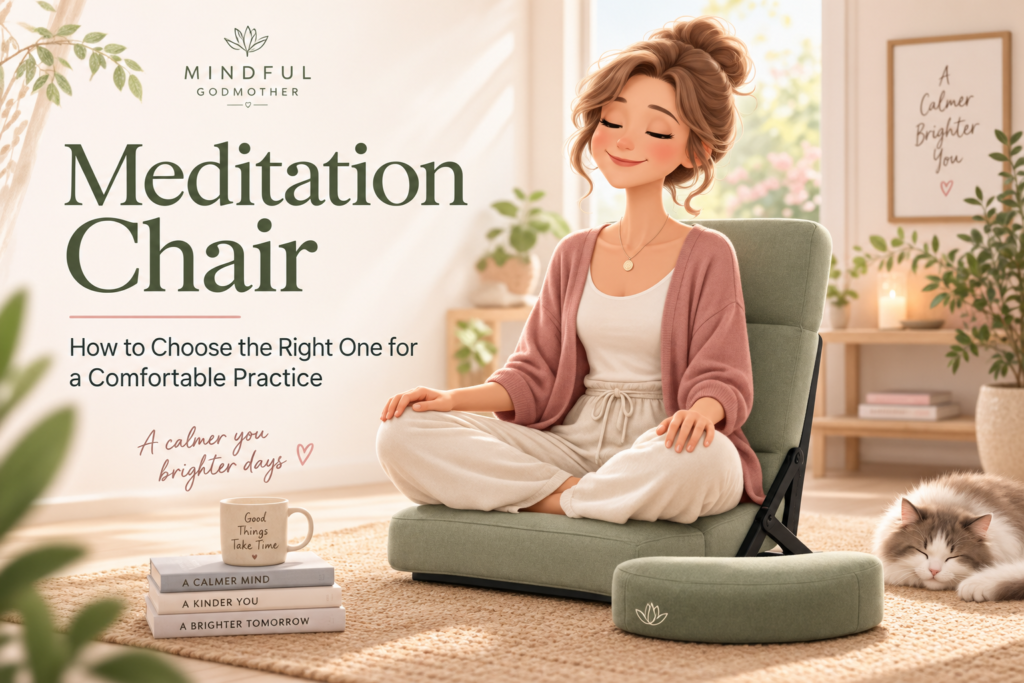
A meditation chair is simply a seat that helps you stay comfortable and reasonably upright while you meditate. Some sit directly on the floor and provide back support. Others resemble traditional chairs, kneeling stools, or wide cross-legged seats.
But before buying one, there is something important to know:
You do not need a special chair to meditate.
Mayo Clinic recommends finding a comfortable position and maintaining good posture during meditation, while NHS mindfulness guidance specifically includes sitting upright in a chair as an appropriate way to practice.
The best meditation chair isn’t necessarily the most expensive one.
It is the chair that allows your body to become quiet enough that you can spend less time thinking about how you’re sitting—and more time actually meditating.
Here’s how to find one that works for you.
What Is a Meditation Chair?
A meditation chair is a chair or supportive seat used to make seated meditation more comfortable.
Depending on the style, it may provide support for your:
- lower back
- hips
- knees and legs
- pelvis
- upright sitting posture
The term “meditation chair” actually covers several different kinds of seating.
You may find:
- floor meditation chairs with back support
- cross-legged meditation chairs
- traditional upright chairs
- kneeling meditation chairs
- meditation benches
- meditation cushions with additional back support
Some are designed specifically for meditation. Others are multipurpose floor chairs that happen to work very well for mindfulness, breathing exercises, journaling, and meditation.
Do You Really Need a Meditation Chair?
Probably not.
And that’s good news.
Meditation doesn’t require expensive equipment, a dedicated meditation room, or a picture-perfect lotus position.
If you can sit comfortably in a normal chair, you already have a perfectly good place to meditate.
Mayo Clinic’s meditation guidance says you can meditate sitting, lying down, walking, or in other positions, with comfort being an important part of the practice.
A dedicated meditation chair becomes more useful when your current position repeatedly gets in the way of your practice.
You might consider one if:
- sitting directly on the floor is uncomfortable
- your lower back becomes tired during meditation
- your hips feel tight when sitting cross-legged
- your knees or ankles dislike floor sitting
- you frequently shift positions because you’re uncomfortable
- you want to gradually meditate for longer periods
- you prefer floor meditation but want back support
- you want a dedicated meditation space in your home
A chair won’t make meditation effortless.
But removing unnecessary physical discomfort can make it easier to stay with the practice.
Benefits of Using a Meditation Chair
The main advantage of a meditation chair isn’t that it makes you “better” at meditation.
It simply makes sitting easier.
It Can Make Meditation More Comfortable
There is a difference between mindfully noticing ordinary sensations and spending an entire meditation fighting an uncomfortable sitting position.
A supportive meditation chair may help reduce some of those distractions.
The aim isn’t perfect posture.
You want a position that feels both comfortable and alert.
Mayo Clinic’s simple meditation guidance similarly recommends becoming comfortable on a chair or cushion while keeping the back straight and feeling relaxed but alert.
It May Help With Longer Meditation Sessions
Five minutes of floor sitting might feel completely manageable.
Twenty minutes may not.
As your sessions become longer, small posture issues can become much more noticeable.
A chair that supports your preferred sitting position may make 10-, 15-, or 20-minute practices feel more approachable.
It Makes Meditation More Accessible
Not everyone comfortably sits cross-legged.
And being able to perform lotus pose is not a requirement for mindfulness.
Harvard Health recommends using a chair if sitting on the floor is uncomfortable or getting up from the floor is difficult.
Chair meditation can therefore be a wonderful option for beginners, older adults, people with limited mobility, or simply anyone who prefers chairs.
It Can Help Create a Meditation Ritual
There can also be something helpful about having a dedicated meditation spot.
When you repeatedly return to the same chair for meditation, breathing, or quiet reflection, sitting there may gradually become a cue to slow down.
You could place your chair beside:
- a small plant
- a comfortable blanket
- a journal
- headphones
- a meditation timer
- a soft lamp
You certainly don’t need all of these.
One comfortable chair in a quiet corner is enough.
Types of Meditation Chairs
Before shopping, it helps to understand the different options.
1. Floor Meditation Chair With Back Support
This is probably the style most people imagine when searching for a meditation chair with back support.
The chair sits directly on or close to the floor and usually includes a padded seat and supportive backrest.
Many models also have adjustable reclining positions.
This style lets you retain the feeling of floor meditation while getting more support than you would from a cushion alone.
Best for: people who enjoy sitting near the floor but want additional back support.
2. Cross-Legged Meditation Chair
Some chairs have unusually wide seats or separate platforms that give your legs more room.
They’re sometimes described as:
- cross-legged chairs
- yoga chairs
- meditation office chairs
- active sitting chairs
These can be useful if you naturally like changing between conventional sitting and cross-legged positions.
Best for: people who frequently change sitting positions or want a chair that can serve both meditation and everyday activities.
3. Traditional Upright Chair
Sometimes the best meditation chair is simply a chair you already own.
Sit toward the front or middle of a relatively supportive chair, depending on what feels comfortable, with your feet resting on the floor.
NHS mindfulness guidance suggests sitting comfortably upright and notes that meditation can be practiced in a chair as well as on a cushion or stool.
Best for: beginners, people who find floor sitting difficult, or anyone who prefers traditional seating.
4. Kneeling Meditation Chair
A kneeling chair changes the relationship between your hips, legs, and torso.
Some people find this naturally encourages a more upright position.
However, kneeling is not comfortable for everyone.
Best for: people who already know that kneeling positions feel comfortable for their knees and ankles.
5. Meditation Bench
A meditation bench is commonly used for a kneeling position known as seiza.
The bench sits beneath the pelvis while your lower legs remain folded underneath or beside you.
Meditation benches tend to be compact and easy to store.
Best for: people who prefer kneeling meditation and want a minimalist setup.
6. Meditation Cushion
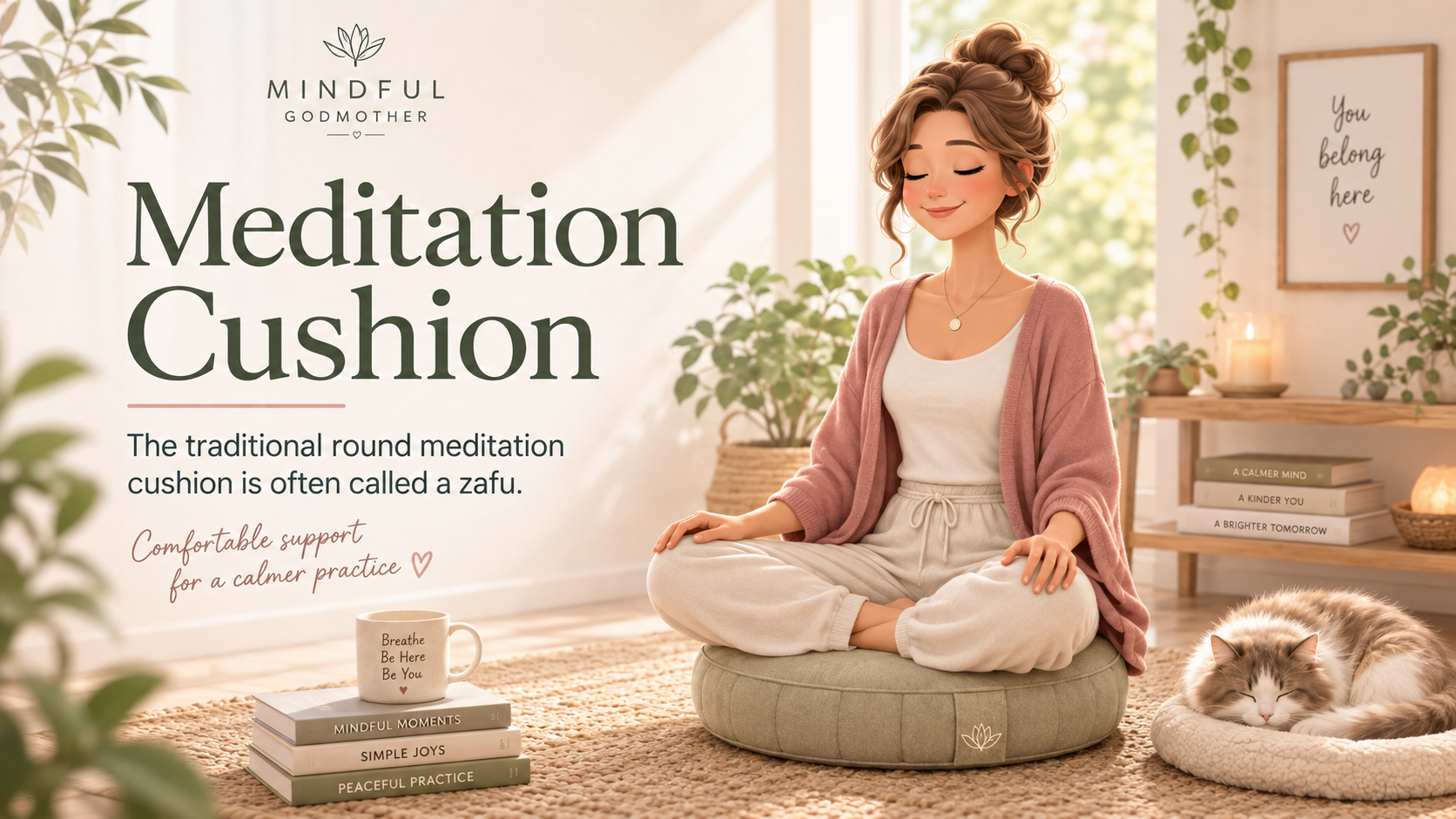
A traditional meditation cushion, often called a zafu, raises your hips above the floor while allowing your knees to settle downward.
It isn’t technically a chair, but it may be all the support you need.
Best for: people who already enjoy floor sitting and don’t need a backrest.
Top 3 Meditation Chairs Worth Considering
If you’ve decided that a floor meditation chair with back support would make your practice more comfortable, these three models offer different advantages.
I prefer thinking about them as three options for three different kinds of meditators, rather than trying to declare one chair universally perfect for everyone.
Note: Product availability, colors, specifications, and prices can change. Check the current Amazon listing before purchasing.
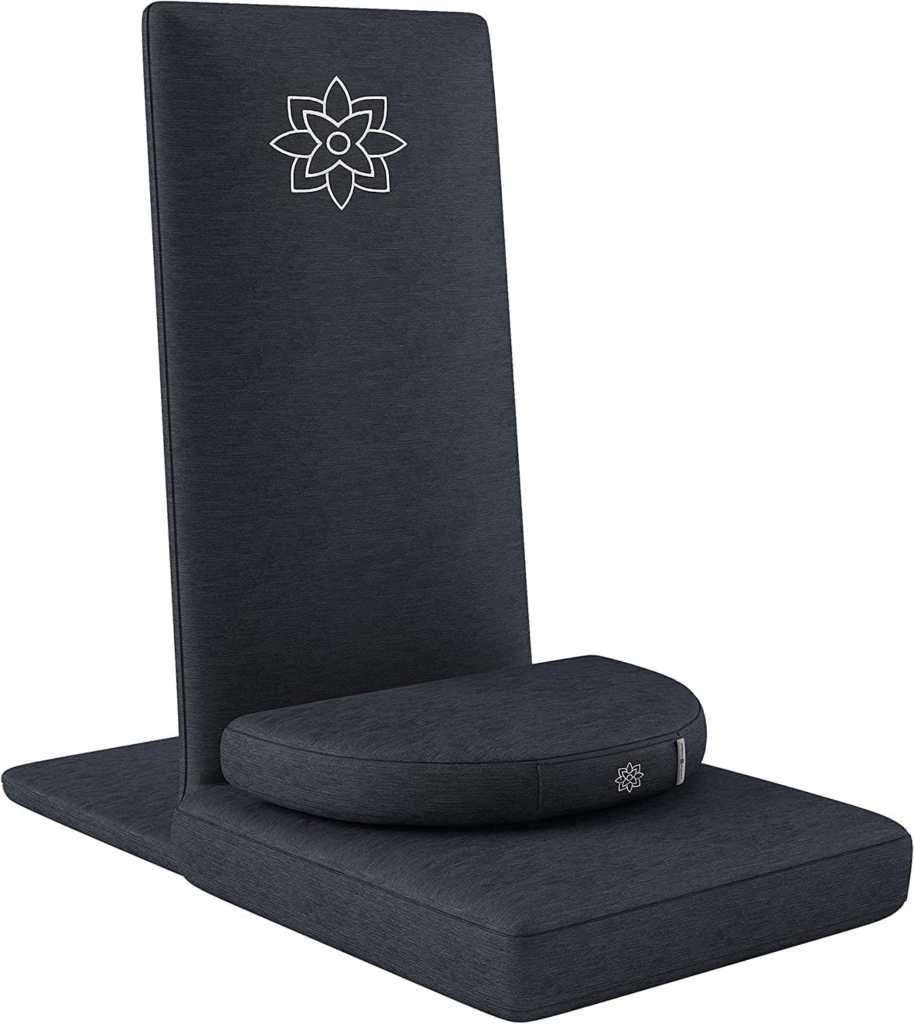
1. Mindful Modern Folding Pro Meditation Chair — Best Overall for Dedicated Meditation
If you’re looking for a chair designed specifically around meditation rather than a general-purpose floor chair, the Mindful Modern Folding Pro Meditation Chair is the first one I would consider.
It combines an adjustable floor chair with a detachable half-moon buckwheat meditation cushion.
The backrest has five adjustable positions, allowing you to experiment with the angle that feels most supportive for your practice. The chair also folds flat, which is helpful if you don’t have a permanent meditation space.
The included buckwheat cushion is especially useful because raising the hips slightly can feel more comfortable for some cross-legged sitting positions.
Product information currently lists features including:
- five adjustable backrest positions
- a folding design
- a metal frame
- soft upholstery
- a detachable half-moon buckwheat cushion
- no assembly required
Best for: someone who meditates regularly and wants a chair built specifically around meditation.
What I like: The combination of adjustable back support and a proper meditation cushion makes this the most meditation-focused option of the three.
Something to consider: It is more substantial than a simple cushion and may be more than you need if you only meditate occasionally.
Mindful Godmother pick: Best overall for a dedicated home meditation space.
2. malu Extra Large Padded Floor Chair — Best Value and Portability
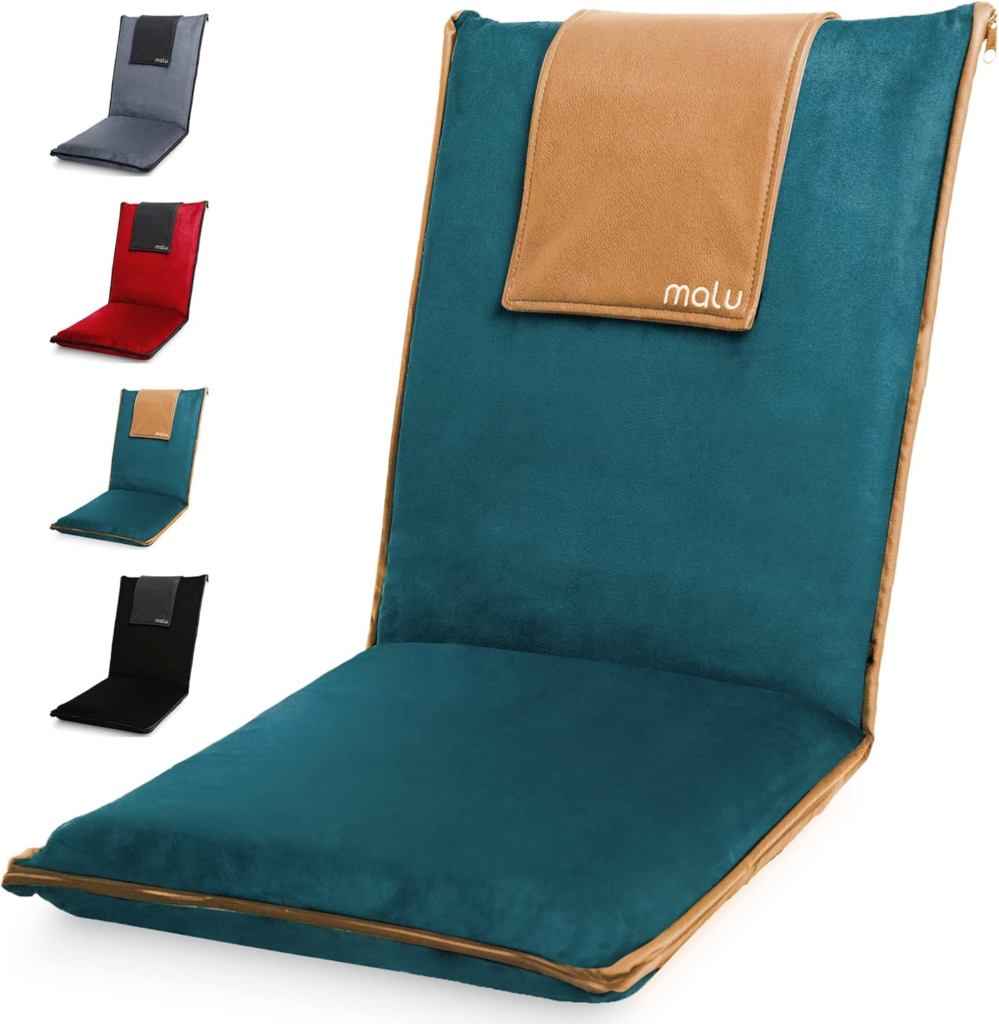
The malu Extra Large Padded Floor Chair is a good middle ground between a meditation-specific seat and an everyday floor chair.
It has five adjustable backrest positions, a thick foam-padded seat, and a folding design.
One particularly practical feature is the removable microsuede cover, which can be machine washed. It also includes a shoulder strap, making the chair easier to carry if you attend meditation groups, retreats, yoga classes, or simply want to move it between rooms.
Current product specifications describe:
- five adjustable positions
- foam padding
- foldable construction
- a shoulder carrying strap
- removable machine-washable microsuede cover
- an easy-clean bottom surface
Best for: beginners or anyone who wants a portable meditation chair without creating a permanent meditation area.
What I like: It’s versatile enough to use for meditation, reading, journaling, or simply sitting on the floor.
Something to consider: Like many lightweight floor chairs, it may not provide the same substantial feeling as a heavier dedicated meditation seat. Check the current dimensions and weight capacity before ordering.
Mindful Godmother pick: Best balance of price, portability, and practicality.
3. BIRDROCK HOME Adjustable 14-Position Memory Foam Floor Chair — Best for Plush Comfort
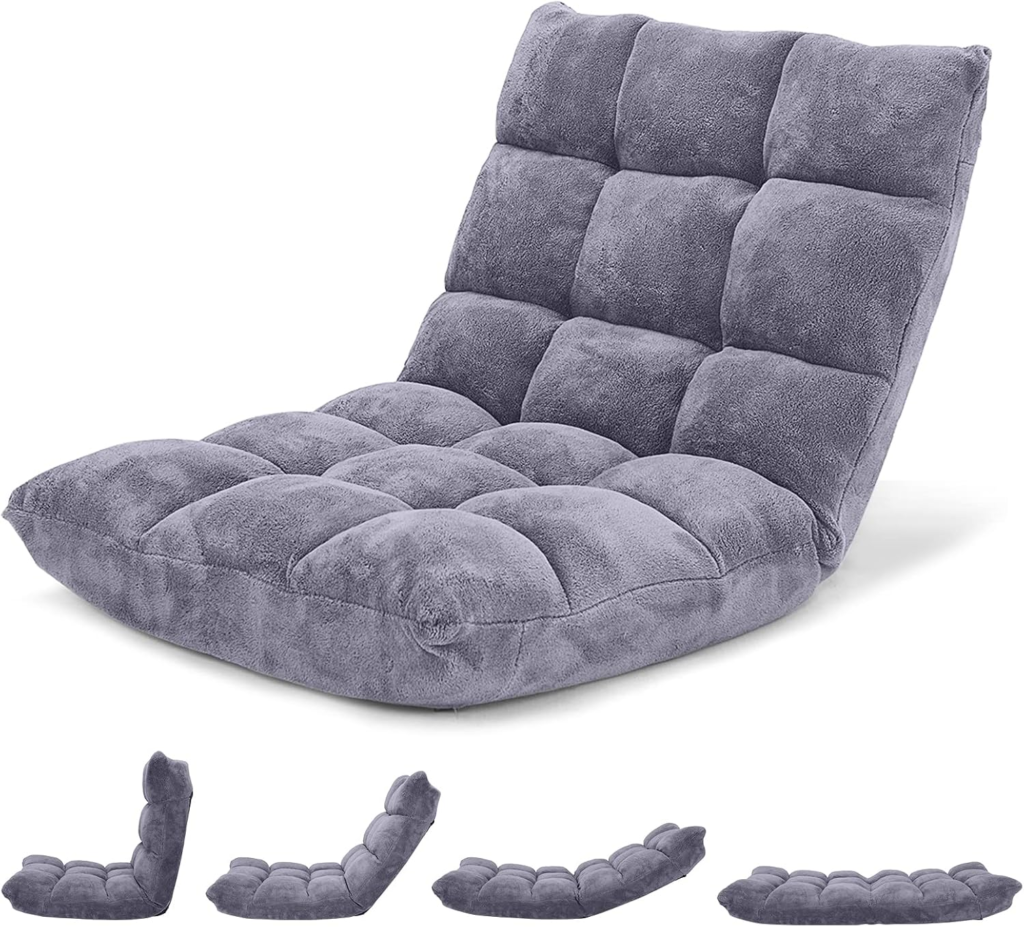
If comfort is your biggest priority, the BIRDROCK HOME Adjustable 14-Position Memory Foam Floor Chair takes a different approach.
Rather than being designed specifically for meditation, it is a multipurpose floor chair filled with chopped memory foam.
The biggest advantage is adjustability.
It offers 14 positions ranging from upright seating to reclining and lying flat. This makes it useful not only for meditation, but also for reading, relaxing, or journaling.
Current product descriptions list:
- 14 adjustable positions
- chopped memory foam filling
- soft plush upholstery
- fold-flat storage
- no assembly required
- use for meditation, reading, gaming, or extra seating
Best for: someone who wants a soft, multipurpose floor chair that can also be used for meditation.
What I like: The memory foam and wide range of adjustment positions make it the most relaxation-oriented option.
Something to consider: Because it isn’t meditation-specific, people looking for a traditional upright meditation setup may prefer the Mindful Modern chair.
Mindful Godmother pick: Best for comfort and multipurpose use.
Quick Comparison: Which Meditation Chair Should You Choose?
| Meditation Chair | Best For | Key Feature |
|---|---|---|
| Mindful Modern Folding Pro | Regular meditation | Meditation-focused design + buckwheat cushion |
| malu Padded Floor Chair | Beginners and portability | Lightweight, washable and foldable |
| BIRDROCK HOME 14-Position Chair | Comfort and multipurpose use | Memory foam + 14 positions |
If I were creating a dedicated meditation corner, I would start with the Mindful Modern Folding Pro.
If I wanted something portable and versatile, I would look at the malu Floor Chair.
And if I wanted something soft enough for meditation, reading, and relaxing, I would consider the BIRDROCK HOME chair.
But don’t choose based only on features.
Your body has the final vote.
Meditation Chair vs. Meditation Cushion
Do you actually need a chair, or would a cushion be enough?
Consider a meditation chair if:
- you want back support
- floor sitting feels uncomfortable
- getting up from the floor is difficult
- you prefer more substantial support
- you frequently change positions
- you want a dedicated meditation setup
Consider a meditation cushion if:
- you already enjoy sitting on the floor
- your hips and knees are comfortable
- you don’t need back support
- you want something compact
- portability is important
You can also combine the two.
A small meditation cushion placed on a floor chair may raise your hips and change the sitting angle enough to make cross-legged meditation more comfortable.
How to Choose the Best Meditation Chair for You
Rather than asking, “What is the best meditation chair?”
Ask:
What makes me uncomfortable when I meditate now?
The answer will tell you much more about what you need.
1. Think About Your Preferred Sitting Position
How do you naturally sit when you’re comfortable?
Perhaps you prefer:
- both feet on the floor
- cross-legged
- kneeling
- one leg folded
- alternating between positions
Your chair should accommodate your body rather than forcing your body to fit a particular meditation image.
2. Look at Back Support
If you’re specifically shopping for a meditation chair with back support, check:
- backrest height
- backrest angle
- adjustability
- firmness
- whether the chair keeps you upright or encourages deep reclining
Meditation usually works best when you’re comfortable without becoming so reclined that you start drifting toward sleep.
3. Check the Seat Width
This is particularly important for cross-legged meditation.
A chair that seems wide enough when you’re sitting normally can suddenly feel very small once you fold your legs.
Check the measurements before ordering.
Better still, sit in your preferred meditation posture at home and measure roughly how much width you naturally use.
4. Consider Seat Firmness
Softer isn’t always better.
If a seat compresses deeply, your pelvis may sink and your sitting position may become less comfortable over time.
Some people prefer the supportive feeling of a firmer meditation cushion, while others enjoy memory foam.
Neither is universally better.
5. Consider Adjustability
An adjustable backrest can be helpful if:
- you’re unsure which angle you’ll prefer
- multiple people will use the chair
- you’ll also use it for journaling or reading
- your preferred position changes from day to day
However, more adjustment doesn’t automatically mean a better meditation chair.
A simple chair that fits you well can be better than a complicated chair with 14 settings you never use.
6. Think About Storage
Do you have a permanent meditation corner?
If not, folding matters.
Before ordering, check whether the chair can:
- fold flat
- slide under your bed
- fit inside a closet
- move easily between rooms
This may sound like a small consideration, but a chair that becomes an inconvenience can quickly become a chair you stop using.
7. Check the Cover
If you’re going to use the chair frequently, washable materials are useful.
Look for:
- removable covers
- machine-washable fabric
- wipe-clean surfaces
- durable upholstery
This matters even more if you have pets or children—or if your meditation routine often includes a cup of tea nearby.
How to Sit in a Meditation Chair
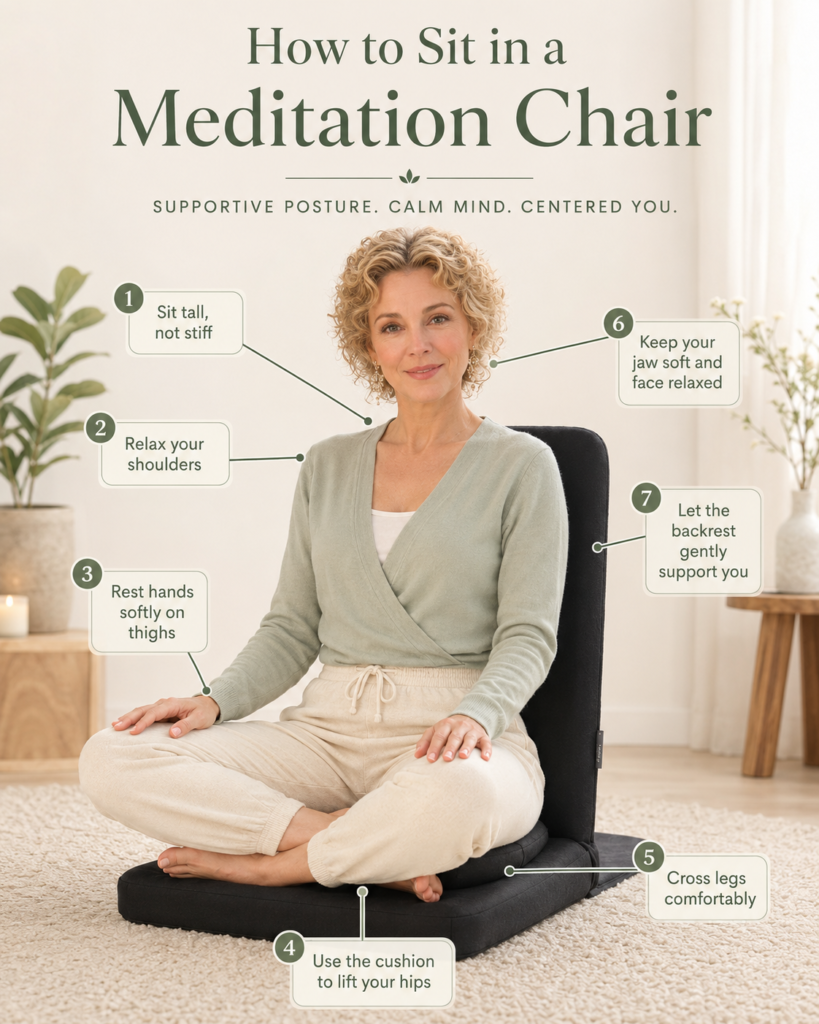
There isn’t one perfect meditation posture.
Start by sitting in a way that feels stable.
If you’re using a conventional chair, allow your feet to rest comfortably on the floor.
If you’re using a floor meditation chair, arrange your legs in whatever supported position feels natural.
Let your hands rest on your thighs or in your lap.
Allow your shoulders to soften.
Let your jaw relax.
Instead of forcing your spine rigidly straight, imagine gently creating a little more space through your torso.
You want to feel upright without feeling stiff.
NHS mindfulness guidance describes meditation posture as comfortable and upright, with the back straight but not rigid.
Once you’re settled, notice your breathing.
One inhale.
One exhale.
Nothing complicated.
You have begun.
What If Your Meditation Chair Is Still Uncomfortable?
Don’t immediately assume you’ve chosen the wrong chair.
Small adjustments can make a surprisingly large difference.
Try:
- placing a small cushion behind your lower back
- putting a folded blanket beneath your feet
- slightly raising your hips
- changing the backrest angle
- changing your leg position
- shortening your meditation session
And move when you need to.
Meditation isn’t a competition to see who can tolerate discomfort the longest.
If sitting causes persistent pain, numbness, or other significant physical symptoms, consider speaking with an appropriate healthcare professional rather than trying to solve the issue solely with meditation furniture.
Can You Use an Office Chair for Meditation?
Absolutely.
Your office chair can become a meditation chair for five minutes.
Move slightly away from your desk.
Put your phone aside.
Place your feet on the floor.
Rest your hands in your lap.
Close your eyes or soften your gaze.
Notice five slow breaths.
Continue for as long as feels useful.
No special equipment required.
Can You Meditate in a Recliner?
Yes.
Meditation can be practiced in many positions.
However, reclining deeply may make you sleepy.
For an alert mindfulness or breath-awareness meditation, you may prefer a more upright position.
For relaxation, a body scan, or preparation for sleep, reclining may be exactly what you want.
Choose the position that supports the type of meditation you’re doing.
Is a Meditation Chair Worth It?
A meditation chair can be worth buying when it solves a real problem.
For example:
Problem: My back gets tired while sitting on the floor.
Possible solution: A floor meditation chair with back support.
Problem: I can’t comfortably sit cross-legged.
Possible solution: A traditional upright chair.
Problem: I want to meditate cross-legged but my normal chair is too narrow.
Possible solution: A wider floor or cross-legged meditation chair.
Problem: I never seem to make time for meditation.
Possible solution: Perhaps a dedicated meditation corner will help—but buying a chair isn’t necessarily the answer.
Before purchasing anything, try meditating with furniture you already have for a week.
Experiment with:
- a dining chair
- a folded blanket
- your sofa
- a meditation cushion
- a firm pillow
You’ll learn what your body needs much more quickly than you will by scrolling through hundreds of products.
Creating a Simple Meditation Corner
Once you’ve found somewhere comfortable to sit, the rest can stay simple.
You might add:
- a small rug
- a blanket
- a plant
- soft lighting
- headphones
- meditation music
- a timer
- a journal
If you enjoy beginning your day quietly, your meditation chair could also become the place where you practice a short morning meditation.
And if you’re exploring other ways to support your practice, you might enjoy learning about the benefits of meditation or exploring useful meditation gadgets.
The important thing is not to turn creating your meditation space into another project you have to finish before you’re allowed to meditate.
Your meditation corner doesn’t need to be perfect.
It only needs to invite you back.
Frequently Asked Questions About Meditation Chairs
What is the best chair for meditation?
The best meditation chair is one that allows you to sit comfortably, remain reasonably upright, and maintain your preferred meditation position without unnecessary strain. Different bodies need different kinds of support.
Do I need a special meditation chair?
No. You can meditate perfectly well using a normal chair, cushion, bench, or other comfortable position. A specialized meditation chair is optional.
Are meditation chairs good for beginners?
They can be. Beginners sometimes assume that they must sit cross-legged on the floor, which can create unnecessary discomfort. A supportive chair can make meditation feel much more approachable.
Is a meditation chair with back support better?
Not necessarily.
Some people prefer having their back self-supported, while others find a backrest helps them stay comfortable for longer periods.
The right choice depends on your body and your practice.
Is it better to meditate in a chair or on the floor?
Neither is inherently better.
Meditation can be practiced in either position. NHS, Mayo Clinic, and Harvard guidance all recognize sitting in a chair as a valid option.
Can I sit cross-legged in a meditation chair?
Many floor meditation chairs are designed to accommodate cross-legged sitting, but dimensions vary considerably.
Always check the usable seat width before purchasing.
Can I use a meditation chair for yoga?
Some floor chairs can be useful during seated breathing exercises, gentle stretching, or restorative practices, but this depends on the chair and the activity.
Follow the manufacturer’s intended uses and don’t use the chair as support for movements it wasn’t designed to handle.
How much should I spend on a meditation chair?
There is no required amount.
Start with what you already own.
If you later decide to buy a meditation chair, prioritize dimensions, sitting style, support, durability, materials, and return policy rather than assuming that the most expensive chair will automatically be the most comfortable.
The Best Meditation Chair Is the One You Will Actually Use
A meditation chair can make your practice more comfortable, particularly if sitting directly on the floor doesn’t suit your body.
But the chair is only a support.
- You don’t need the perfect meditation room.
- You don’t need perfect posture.
- You don’t need to sit in lotus pose.
And you definitely don’t need to buy a collection of meditation equipment before you can begin.
Find somewhere reasonably comfortable.
Sit down.
Notice the weight of your body being supported beneath you.
Feel one breath arrive.
Feel one breath leave.
When your attention wanders, gently come back.
The best meditation chair is ultimately the one that makes it a little easier for you to do that again tomorrow.